
 Qwote
Qwote

Requests and documents
From requests to data ready to work with.
Example flow
From the request to work ready to handle.
Email · form · attachment
Request
It arrives as it does today, through the same channels.
AI
Data recognised
Type of request, references, dates, attached documents.
Exceptions
Missing data or ambiguous case
The request reaches a person with what was recognised and what is missing: they complete it, decide and put it back in the flow.
AI · integration
Customer or case
Linked to the right customer record and case.
Your system
Ticket or task
Created in the right system and assigned to whoever handles it.
What software can do
The details that make the flow reliable.
Data checks
It checks what it extracted against existing customer records and cases and flags what does not add up, before it enters your systems.
Task assignment
Every task goes to the right person or team, according to rules you define.
Traceability
Every automatic operation is logged: what was recognised, what was created, who completed the exceptions.
Real work
Insurance agency · CRM
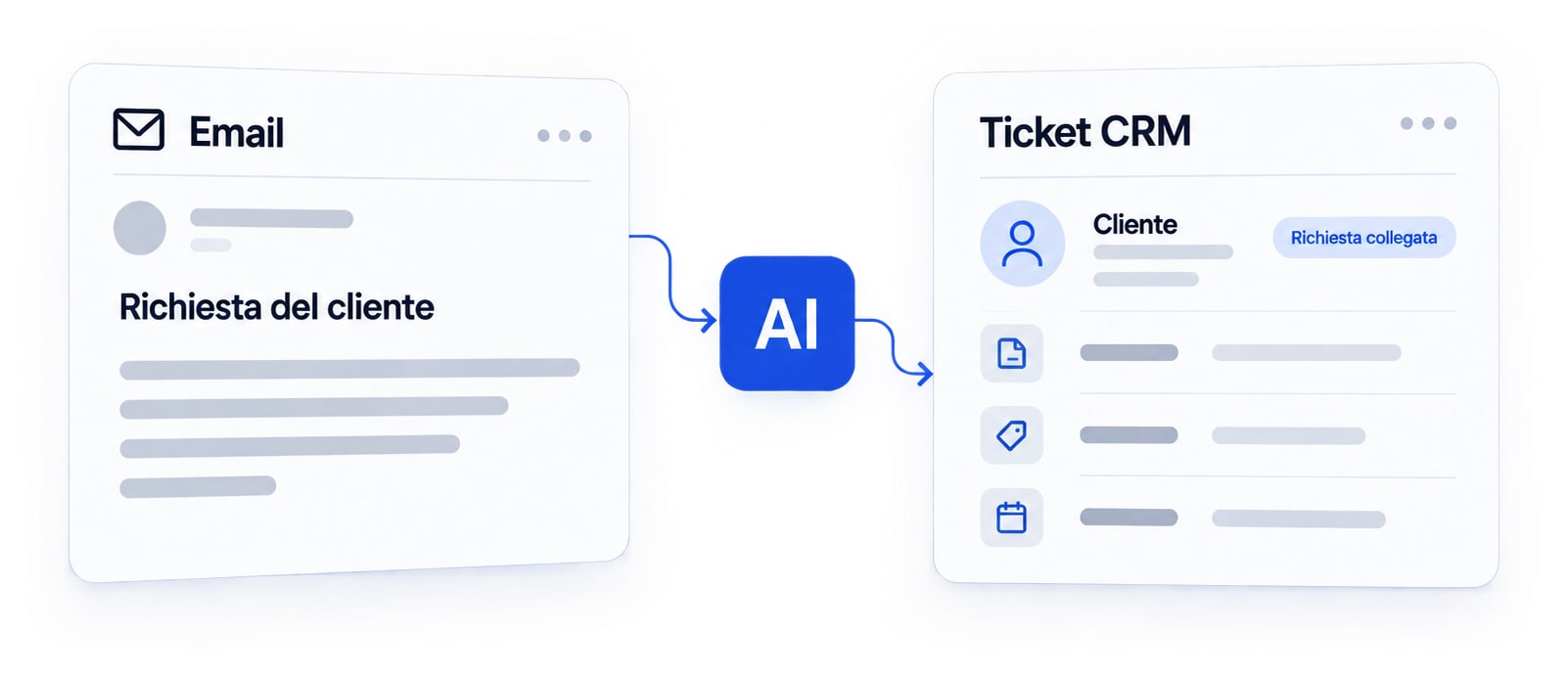
From emails to CRM tickets, with AI
Customer requests arrived by email and were handled by hand. Now AI recognises the request, links it to the customer and opens the ticket in the CRM; communication stays in one place. Where it can, it replies; the rest reaches a person with the context ready.
- Automatic tickets
- Customer linked
- Handover to an operator
What do we need to start?
A set of real requests, anonymised if needed: emails, forms, typical attachments and a few difficult cases. Then the rules you use to route them today, and access to the system they need to end up in.
Which requests are a good fit?
Those that arrive often and follow a recognisable pattern, even when written freely: support, orders, cases, documents to register. If every request is unique, we start from the part that repeats.
How is the AI’s work checked?
During the trial, results are compared with the decisions people make on the same cases. In use, anything that is not recognised with confidence, or does not match customer records and cases, goes to a person, and every operation is logged.
Do you have to change the tools you use?
No. Requests keep arriving through the same channels and end up in the CRM, management system or ticketing tool you already use. At the start we check how to connect to the destination system.
Let’s start from how requests arrive today.
A few real examples are enough: where they come from, who reads them, where the information ends up.