


Quotes and offers
Less preparatory work. More room to decide the offer.
Where the work piles up
Three moments before the price.
01
Gather the information
Requests from emails, forms or calls brought into a single shape. Software flags what is missing and asks for it.
02
Prepare a basis to assess
Data from price lists, ERP and history; rules and constraints applied; a configuration or first estimate ready to review.
03
Handle checks and approvals
Non-standard cases are isolated and go to whoever has to approve them, with all the context.
Software prepares. People decide.
Our own case
 Qwote, built for the Methodia process.
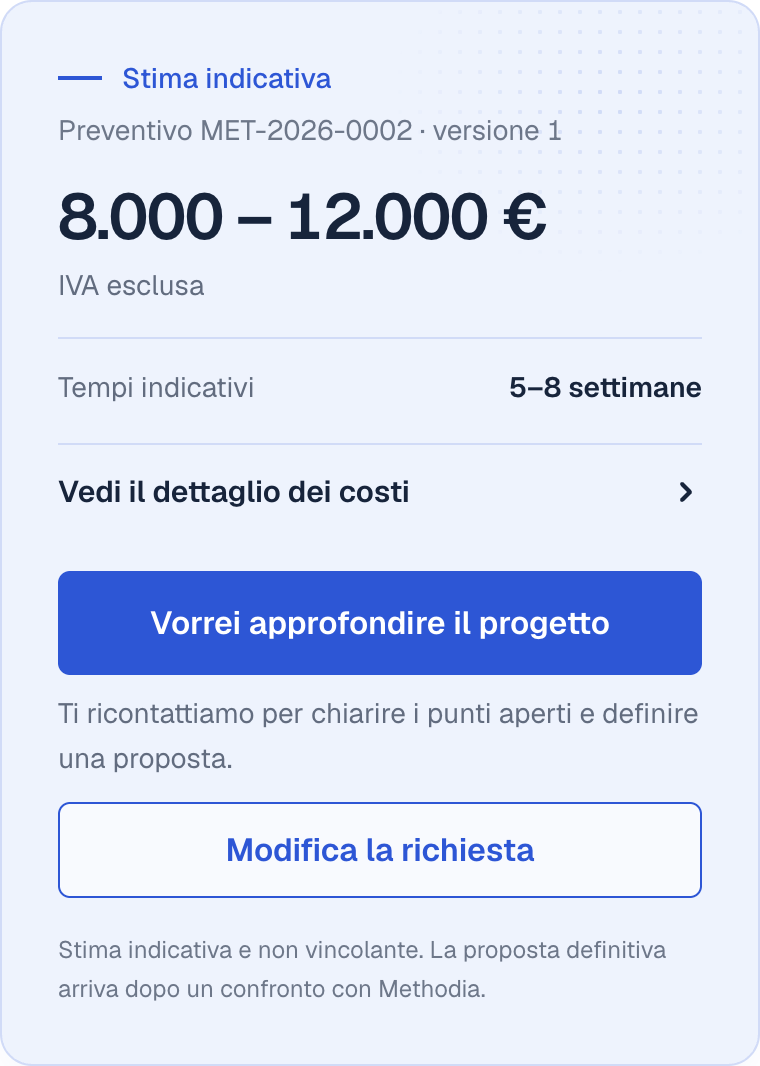
We use it for software project requests: it reads the description, asks questions only if something is missing and produces a first indicative estimate.
Another company’s process needs its own data, rules and integrations: Qwote shows the principle, not a model to copy.
What do we need to start?
A few recent quotes with the requests they came from, the price lists or pricing sources, and the rules that the people preparing them know today: discounts, constraints, possible combinations, when approval is needed.
Do price lists and rules need rewriting?
Not necessarily. We start from where they live today: management system, spreadsheets, documents. If they are scattered or inconsistent, putting them in order can already be the first useful result.
Who approves the offer?
Whoever approves it today. The software prepares the configuration or estimate and isolates non-standard cases; discounts, exceptions and the final price remain a commercial decision.
What drives the complexity?
The number of products, services and variants, how explicit the rules are and where the data to retrieve lives. A first flow on a single family of offers lets you assess it before extending it.
Tell us how you prepare quotes today.
A couple of recent examples are enough: where requests come from, what data is needed, who decides.